Showing posts with label Applegate AVA. Show all posts

Thursday, July 12, 2012

Wooldridge Creek Vineyards and Winery - Grants Pass, Oregon


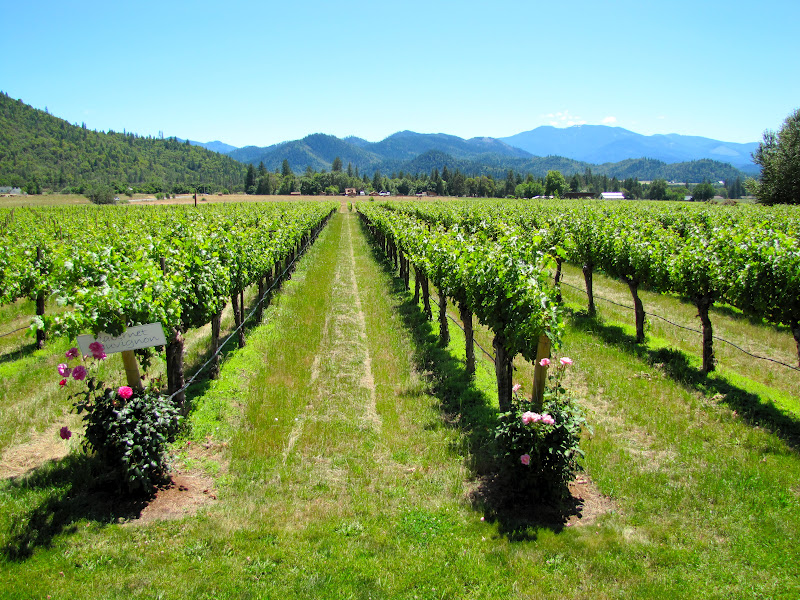
My third and final stop of the first day of my tour of the Applegate Wine Trail was at Wooldridge Creek Winery. While the previous wineries were located on the valley floor, Wooldridge is located on a rolling hillside overlooking the Applegate River Valley at an elevation of about 1,800 feet. 

The winery and vineyard was founded by Ted and Mary Warrick in 1978. They named it after the creek that runs through the valley, which is named after the Wooldridge family who first settled the property in the 1850s. Since then the vineyard has been expanded to 56 acres planted in twelve varieties: Cabernet Sauvignon, Merlot, Cabernet Franc, Syrah, Chardonnay, Pinot Noir, Viognier, Sangiovese, Zinfandel, Malbec, Petit Verdot and Tempranillo. The vines are densely planted at 1200 vines per acre, running north to south to allow for maximum exposure to the sun. All the vineyards are planted on Josephine soil, a soil type known for its excellent drainage.


In 2002, Ted and Mary met winemakers Greg Paneitz and Kara Olmo, who were in the area looking for an ideal place to put their winemaking skills to good use. Until then, grapes from Wooldridge Creek Vineyard had been sold almost entirely to wineries around the state, with only a small amount being made into custom wine under the Wooldridge Creek label. Once they met together they saw an opportunity to combine the Warricks’ fruit with Greg and Kara’s winemaking skills and they partnered to create Wooldridge Creek Winery.


Wooldridge Creek Winery is committed to practicing sustainable winemaking. This includes the grapes from the 200-acre vineyard which are organically grown and their wines carry the seal of LIVE (Low Input Viticulture and Enology), TerraVow, Salmon-Safe and Oregon Certified Sustainable Wine. Wooldridge Creek produces about 2,500 cases a year of wine, both varietals and blends, many of which are available only at the winery.


At the winery visitors can view the wine production area, view the barrel room in the man-made wine cave and taste the wines in the tasting room. They can also sit out on the patio or lawn that overlooks a beautiful flower garden, the vineyards and the valley below.


While visiting I sampled the following wines:

My first wine was the 2011 Viognier. This wine has very floral aromas followed by pronounced orange peels and tropical pineapple notes. On the palate it is off dry and yet maintains balanced acidity followed by a medium (+) length finish. $24

The second wine was the 2011 Rosé of Tempranillo, Applegate Valley. This wine has subtle aromas of strawberries, dried cranberries, and a hint of spice. On the palate it is fresh and vibrant with a medium (+) length finish. A really nice summer wine for $18 a bottle.

The third wine was the 2009 Syrah, which is blended with 2% Viognier. On the nose it has fresh red and black berry notes with subtle underlying floral notes. On the palate the wine is dry with intense blackberries, blueberries, medium tannins, medium acidity, and medium (+) length. This wine sells for $36 a bottle.

The final wine was the 2008 Reserve Pinot Noir. This wine has aromas of black cherries, ripe red plums, black tea and a hint of oak and spice. On the palate it is dry, with medium acidity, medium (+) length finish. This wine sells for $36 a bottle.

To visit or for more information:

Woodlrige Creek Vineyards and Winery
818 Slagle Creek Rd
Grants Pass, Oregon 97527
Phone: 1-541-846-6364

Tuesday, July 10, 2012

Troon Vineyard – A Pioneering Winery in Grants Pass, Oregon


The second stop of the first day of my adventure through the Oregon wine country along the Applegate Wine Trail was at Troon Vineyard. Surrounded by steep tree covered hills the winery and vineyard is absolutely beautiful.


The winery was founded by Dick Troon who served in the United States Marine Corps during World War II and studied civil engineering at the University of California. He worked on infrastructure at Vandenberg Air Force Base, Cape Canaveral and Disneyland. In 1961 Troon moved to the Rogue Valley to take up farming. In 1972 he purchased the 32 acres of land selecting the Kubli Bench, a microclimate in the Applegate Valley of Southern Oregon. The warm days and cool nights, along with the excellent soil conditions, provide ideal conditions for growing premium wine grapes. The vineyard site receives the maximum daily exposure to sunlight and is located at the perfect elevation for his favorite varietals: Cabernet Sauvignon and Zinfandel. This established Troon as one of the pioneers of the Rogue Valley’s modern wine industry being the first to plant Zinfandel in Southern Oregon. He also served as a mentor for others and brought in instructors to teach wine-grape growing and other winery skills. Troon Winery emerged in 1993 when the operation began bottling its own wine after selling to others for nearly two decades. 


In 2003, two decades after being founded, Troon moved to a nearby house and sold the winery to Chris Martin and his father Larry who took the expanding production to the next level. Additional vineyards were planted from 2004 to 2011 bringing the vineyard planting to close to 40 acres with over 20 different varietals. They then purchased two adjoining properties to bringing the estate to 100 acres. 


In 2005 construction of the new winery was completed which features a French villa style architecture featuring copper gutters, Spanish tile roofs, extensive cedar work, hand-scraped hickory floors, and a full commercial kitchen utilized when hosting special events and parties. Behind the tasting room are a bocce ball court and a comfortable patio with a water fountain where visitors can enjoy the wine while overlooking the vineyards.

While visiting I sampled the following wines:

My first wine was the 2011 “The River Guide” Dry Riesling. On the nose it has aromas of light green apples, pears and lemon-lime notes. On the palate it delivers crisp green apples, very sharp and vibrant acidity with a hint of minerality. This is an excellent summer wine as it was very refreshing with a medium(+) length finish and it is moderately priced at $16 a bottle.

The second sample was the 2011 Vermentino, Applegate Valley. I can’t recall ever tasting a new world Vermentino as I have never seen one in California. So I was excited to try this wine. On the nose I picked up subtle stone fruits, nectarine, tangerine, and hint of lemon zest. On the palate it is slightly tart, with medium (+) acidity, and a medium length finish. This wine sells for $18 a bottle and I took one home.

The third pour was the 2011 “Jeanie in the Bottle” Rosé made from a blend of Bordeaux varietal red grapes (they didn't say which ones). On the nose I picked up hints of strawberry and watermelon and on the palate it is seemingly off dry with a medium finish. This wine is moderately priced at $14 a bottle.

The fourth wine was the 2010 Druid Fluid Red. This wine was an “accidental” invention, the result of a stuck fermentation that customers came to love so they continued to produce this wine. It is a medium intensity ruby wine with fruity hints of raspberry, cranberries, and a hint of spice. On the palate it is very soft, off dry with medium (-) tannins, no heat with only 12.5 alcohol and a medium length finish. If you know someone who doesn’t like red wines because of the tannin, this would make a great introduction to something other than white or sweet wines. This wine sells for $18.50 a bottle.

The fifth sample was the 2008 Syrah. This wine is garnet in color with pronounced  aromas (given enough time to breath) of blackberries, blueberries, a hint of pepper, and a touch of black licorice. On the palate it has supple medium intensity tannins and a medium length finish. A nice wine for $19.95 a bottle.

The sixth wine was the 2009 Old Vine Meritage, a blend of predominantly Cabernet Sauvignon, Merlot and Cabernet Franc from 35 year-old vines along with small a amount of Malbec and Petit Verdot. On the nose I picked up black currants, black cherry, a hint of chocolate, and a touch of mint. On the palate the wine is fruit forward, with supple medium tannins, medium intensity tannins, followed by a medium length finish. A nice wine that sells for $32 a bottle.

The seventh pour was the 2007 Estate Cabernet Sauvignon. On the nose I picked up black fruits, red currants, a hint of eucalyptus, and a touch of anise. On the palate the wine is youthful, fresh, vibrant and full bodied with medium intensity tannins, medium (+) acidity, medium (+) length finish. This wine sells for $35 a bottle.

The final wine was the 2009 Cabernet Franc Ltd. Reserve 1. This wine has pronounced aromas of black fruits, old leather, pipe tobacco, a hint of anise, just a touch of fruit sweetness followed by medium tannins and acidity. This was my favorite wine in the line-up. Although I primarily came to Oregon to find great bottles of Pinot Noir to take home, I couldn’t pass this one up at $35 a bottle.


To see more pictures of Troon Vineyard, check out Erik Wait’s Wine Country Photography at:


To visit or for more information:

Troon Vineyard
1475 Kubli Road
Grants Pass, Oregon
Phone: 1-541- 846-9900

Thursday, July 5, 2012

Summer 2012 Exploration of the Oregon Wine Country


As I write this it is the second day of my trip and I am in my hotel room in Eugene Oregon. I am already writing my first reviews and editing the pictures and videos but I won’t begin posting them until I return home to the San Francisco Bay Area next week.

My first exploration of the Oregon wine country was in December, 2011. It was my first time to the state and I as I drove through Southern Oregon I was immediately in awe of the beauty of the forest covered mountains and the flowing streams. I was equally impressed with the wines of Southern Oregon. I knew then I wanted to return in 2012. Having been to every American Viticulture Area (AVA) in California and every wine country I was eager for a return up north.

However, it rains 8 months out of the year in this green state. Throughout the year I looked for an opportunity to come up for a three-day weekend (Memorial Day for example) only to be foiled by another forecast of rain. So I had to wait until the first week of July for a week of clear blue skies and warm weather. With Independence Day in the middle of the week and my birthday at the end it was the perfect time to return to Oregon.


Southern Oregon is a 6 ½ hour drive from my home in the San Francisco Bay Area. But just before exiting California I pass by and around Mt. Shasta which remains covered in snow year round. Exploring the wine country isn’t just about tasting great wines, it is about enjoying the view along the way.


Southern Oregon stems from Eugene to the California border. There are four sub-AVAs in Southern Oregon (Umpqua, Rogue Valley, Applegate and Illinois AVAs). The Willamette Valley stems from Eugene up to Portland Oregon and it contains 6 sub-AVAs including Chehelem Mountains AVA, Dundee Hills AVA, Ribbon Ridge AVA, Eola-Amity Hills AVA, McMinnville AVA, Ribbon Ridge AVA, and the Yamhill-Carlton District AVA.

Having been to the Umpqua and the Rogue Valley during my first trip I planned to visit the Applegate AVA on my first day, then the Southern Willamette Valley surrounding Eugene for two days and then head further north to the Northern Willamette Valley the for final two days of my trip.


I visited three wineries in the Applegate AVA on Tuesday and only one during my first day in Eugene. Being the 4th of July and a national holiday (Independence Day) some wineries were closed and others closed early. So I only visited King Estate Winery, but it was absolutely spectacular. I’ll post the review, video and pictures next week so stay tuned!